Origins of the Pilgrimage Site
The history of the Holy Hill pilgrimage site near Olomouc goes back to the beginning of the 17th century, at a time when Europe was convulsed by the Thirty Years‘ War. At those uneasy days, after the year 1623, Samuel Andrýsek, the town clerk from Ratiboř, and his family, decided to move to Olomouc. He got a new job at the Episcopal Consistory. Olomouc was then recovering from an extensive plague epidemic, which left many casualties in the city – 14,236 people had died.
His son Jan Andrýsek, born in 1595, acquired a house in Olomouc, married Anna, the widow of a councillor, and opened wineshop. He often imported wine from Austria. On the way there and back, he often made a stop and had a rest, together with his carters and horses. In the morning, he often took part in the mass in the church of St. Martin in Luleč. Once he made a pledge in the presence of his people that in case he got rich, he would build a church dedicated to Virgin Mary on a hill east of Olomouc. Although he inherited fortune from his brother-in-law, he still postponed the fulfilment of his promise, and the Mother of God herself reminded him twice in a dream.
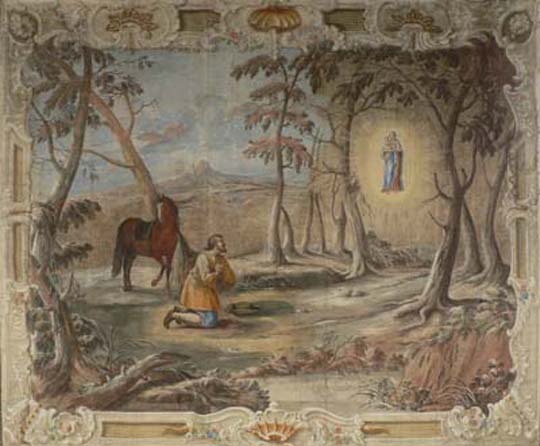 Finally, at the end of February 1629, Andrýsek bought a stout horse from a Burgundy priest and he rode on it through forested landscapes full of snowdrifts. A strong wind came making the way very difficult. In the woods above the village Droždín, the branches of trees loaded with snow heavily lashed his face, and so he veiled his face. A severe snowstorm came to an end only when the horse and the rider got to the top of a hill. Andrýsek unveiled his face and saw a place full of light, similar to that one he saw in his dream in which the Mother of God appeared to him. After saying a prayer of thanks, he went down to the village of Samotišky where he found out that the owner of the forest and that place is a Premonstratensian monastery Hradisko. The severely ill abbot Leodegarius together with the prior Maxmilian Pracher welcomed his plan, and on 13 March 1629 the Olomouc bishopric gave their consent to build a chapel. Later that same year the newly elected abbot Pracher consecrated the cornerstone of the chapel.
Building of the chapel in the grounds of Hradisko monastery started the permanent connection between the pilgrimage site and the Premonstratensian monastery. Construction of a chapel on the Holy Mountain, as the place was originally called, was completed within four years and consecrated by the auxiliary bishop of Olomouc Phillip Breuner on the 3rd April, 1633. Since the previous year already, a stone relief of the Virgin Mary with the baby Jesus had stood on the altar of the chapel. A hermit living in a nearby wooden shack to whom Andrýsek conferred the responsibilities of the sacristian told a story about the miraculous discovery. One morning he was woken up by pilgrims’ singing. He got up quickly to open the chapel for them. But the door was already open, the chapel was full of light and the strange, white-robed pilgrims were putting a painting of the Holy Virgin to the altar with great reverence, and then disappeared. The stunned hermit rushed to Olomouc to tell Andrýsek what had happened. The current view is that the statue is a valuable work of art which was initially placed and worshiped at a suitable place in the open air, and, after completion of construction of the chapel it was placed in it, and later on in the church, and became the Palladium (protective image) of the region.
The respect of the pilgrims towards the image even increased when, at the day of consecration of the chapel, the so far blind nobleman’s son Alexander Bory became sighted during celebration of the mass. The bishop consistory of Olomouc sought a written testimony for this unusual case, which was deposed by the physician Stupani and the burgher Erazim Blitling.
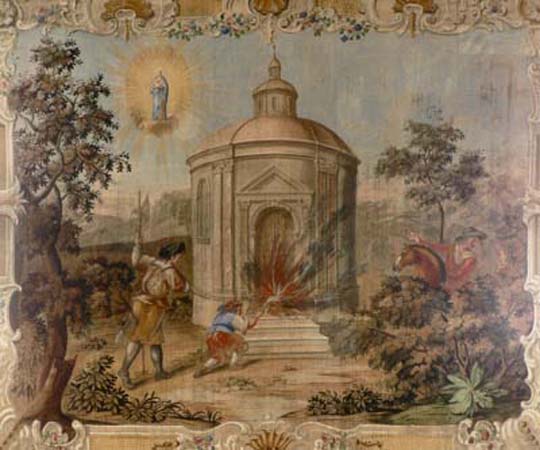 In 1642, the Swedish army came to Olomouc and occupied the city for 8 years, plundering and robbing houses, monasteries and neighbouring villages. In 1645, a Swedish lieutenant lighted a resinous wreath and dropped it into the chapel. After the fire, only bare walls were left. And the miraculous image disappeared.
Andrýsek had another dream. Its content, as he described it to Bedřich Schinal, abbot of Hradisko monastery, was written down as follows: “When the house of God on the Holy Hill had been burnt by the Swedes and stood roofless and destroyed, the Virgin Mary came to me in a dream for the third and last time, as it had been in the poor destroyed chapel, all in ire and sorrow, with baby Jesus in her arms. Seeing the sorrowful Mother of God I was sore afraid…” Andrýsek asked the Premonstratensians to provide their help with chapel reconstruction. When the abbot with his confreres returned to the ruined Hradisko monastery, he immediately arranged for roofing the chapel and clearing its interior, and the divine service was started again.
The miraculous image of the Virgin Mary was delivered to the house of Andrýsek by an unknown man saying: “ Now I am bringing this image to you as it belongs to you” – and then he left quickly without saying anything more.
Till Abolishment of Hradisko Monastery
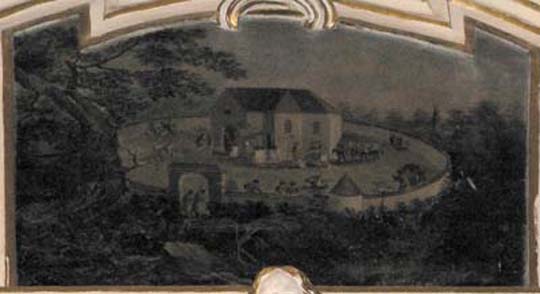 In the post-war period the restored chapel with the miraculous Marian image became again the destination of many pilgrims. However, it was not large enough any longer, and so the abbots from Hradisko thought about rebuilding it into a more spacious church. Abbot Bedřich Sedlecius-Sedlák first requested a written statement from Andrýsek saying that neither he nor his descendants would exercise ownership rights to the old chapel any longer. Suffering from old age and the recent death of his wife Anna, Andrýsek did this without any reservations on 17 June 1667.
The abbot asked the Bishop Charles II. of Lichtenstein to approve the construction of a new church, and patronage of Our Lady of the Visitation. The bishop recommended the imperial architect Giovanni Pietro Tencalla to be the architect for this project. The foundation stone was laid in 1669, and construction works continued quickly. However, the founder of the pilgrimage site did not live to see the new church: Jan Andrýsek died on 10 February 1673. The new church was consecrated on 1 October 1679 by Charles II. of Lichtenstein, the Bishop of Olomouc, under participation of the new abbot of Hradisko, Norbert Želecký of Počenice. This abbot contributed significantly to the future development of the pilgrimage site. He arranged for building a residence for 16 priests taking care of the site, as well as the hospital for twelve poor men. To cover the financial needs of the site, he purchased estate farms Konice and Stražisko near Prostějov.
On 28 September 1705 the Holy Hill was hit with a tragic event when the pilgrimage home – the today’s hospice – was destroyed by fire, and 121 pilgrims died. The victims were buried in the wood behind the church. A funeral chapel of St. Barbara was erected above the funeral place, and in 1784 the Holy Hill cemetery was created round this chapel.
Under abbot benedict Bönisch, elected in 1714, adjacent multi-storeyed buildings were built to both sides of the church, the northern as a residence for priests, and the southern for the prior, with representation halls for abbot’s needs during his stay at the Holy Hill. The master builder was Domenico Martinelli, whi is also considered to be the author of the cloister with the chapel of the Most Holy Name of the Blessed Virgin Mary at the back side of the premises.
Later on, some modifications of the pilgrimage church interior were made, in connection with the cenntenial of the establishment of the pilgrimage site. The Italian Baldassare Fontana was selected as the main architect and executor of the plan of modifications. He did a great job and till nowadays, we can admire the beauty of his stucco and fresco paintings. On the occasion of the jubilee, on 21 September 1732 the miraculous image was decorated with Roman crowns. This was a tribute received by a few churches only at that time.
The Empress Maria Theresa in person visited the pilgrimage site on 19 June 1748, under abbot Ferdinand Václavík, who, in 1784, obtained for basilica the privillages of „minor basilica“. That means that pilgrims visiting the Holy Hill church may be granted the same indulgence as if he had visited the Santa Maria Maggiore Basilica in Rome.
On 18 August 1784, the severely ill abbot Václavík got the decree which abolished Hradisko monastery and the priory on the Holy Hill. The abbot and brothers had to move away within 5 months. This was followed by moveable and estate property lists compilations. Due to them, the pilgirimage church lost lots of valuables that came from pilgrims‘ donations. State officials decided that one or two priests are sufficient for spiritual care and administration at the site, and in April 1785 an independent parish was established on the Holy Hill.
Present Situation
Till the year 1821, parish priest were former member of the Hradisko monastery. Since the churh, due to confiscations, lost also its foundations and therefore the income from them, its technical condition got very bad. In 1834, Jan Rudolf, the archbishop of Olomouc, negotiated with the Emperor Francis II. nullification at least of a part of the property confiscation. Discussions on realligning of the new spiritual administration within the Olomouc archbishop’s consistory went on in next 10 years. It was recommended to submit this task to any of religious orders. After visiting the place and seeing the dismal state of the church, the abbot of the Strahov Premonstratensian monastery in Prague, Jeroným Josef Zeidler accepted this offer. The priests from Strahov were introduced to the Holy Hill on 8 November 1846. Eight priests ensuring spiritual needs of the pilgrimage site and taking care of the necessary repairs and reconstruction, were accommodated there.
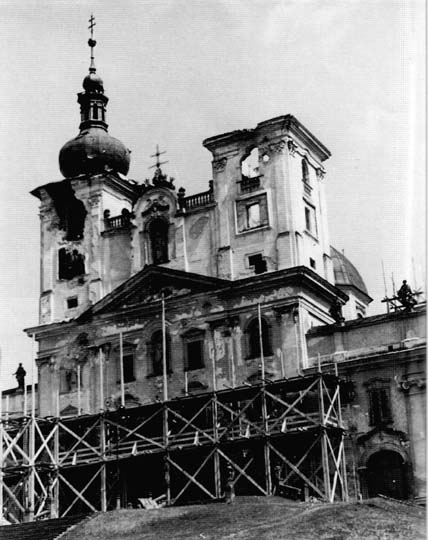 During the First World War the largest bell from the Holy Hill basilica – the 3.250 kg weighing Maria - was confiscated, and even the copper roofing from towers and the dome was taken down. A significant person who contributed to the bloom of the pilgrimage site was the provost Julius Půda. He worked at the place in the period of 1905-1914 as a chaplain and in 1924-1950 as a provost. In that period the church was reconstructed (1930-1932) and got electrical installations and lighting both inside and outside. An so, on anniversary of 300 years of establishment of the pilgrimage site and 200 years from the coronation of the miraculous image, it shined in its full beauty. Půda also contrunuted to renovations of the church significantly damaged by missiles of the Red Army passing the church in the night of 6 May 1945. These reconstruction works were perfomed in the period of 1945-1949, and so the speed of works was admirable.
In 1950, after the communist government came to power, Julius Půda and his confreres were forcibly deported and religious orders for men abolished. For the next forty years the spiriritual care and administration was entrusted to diocesan priests. One of them, P. Gustav Riedl, a native of Šumvald stands out above the others. With love and great sensitivity he planned, and with the help of unselfish group of assocates, restored step-by step the poligrimage site from inside and outside.
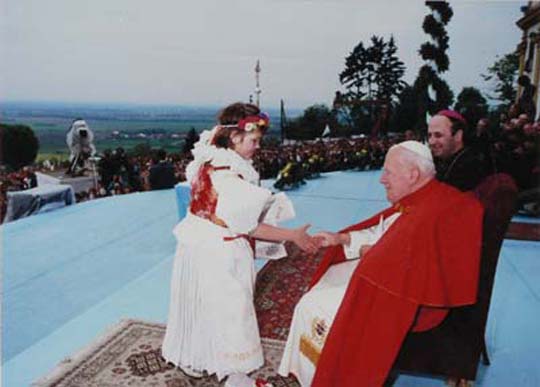 The Premonstratensians returned to the Holy Hill on 11 February 1990, improving and developing the life of this place since then. And, in that period the most significant event for this pilgrimage site took place, in the period when P.Jakub berka was the head of religious service there, the Pope John Paul II. visited the Holy Hill – it was on 21 May 1995. On that occasion, the pilgrimage church was promoted to basilica minor. The Pope’s visit, in particular his meeting with young people, will remain in memories of the participants forever.