Facade
Due to its location, architecture and artistic decoration, the Holy Hill church belongs to brilliant baroque buildings. It is a masterpiece work of artists and craftsmen called up from transalpine countries and from Vienna, working for the bishop of Olomouc and abbots of Hradisko monastery; although a number of Moravian artists did not fall behind them.
Although most Christian churches are west facing, this direction was not kept exactly with the Holy Hill church. Its axis points to the parent Hradisko monastery, and so the priest at the high altar can get an impressive view of the former parent monastery.
Facade of the Church of Visitation
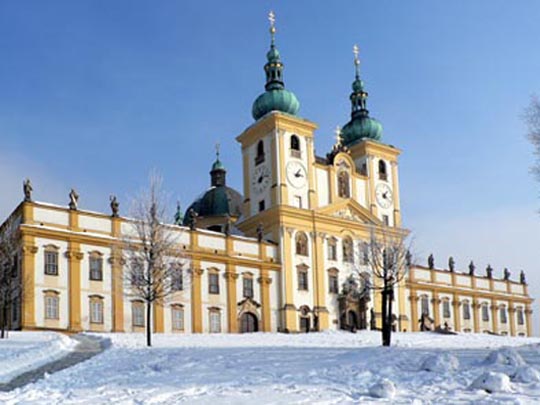 The church main facade was built based on a sophisticated concept. It is vertically divided by pilasters into three fields, and horizontally by a massive cornice into the lower and upper parts. A portal with three valuable statues depicting generosity, fame and hope, created by Josef Winterhalder in 1731, dominates the lower part. Between the sculptures above the entrance there is a stone slab with Latin inscription:
This shrine was built in honour of the visit of the Blessed Virgin Mary to Elizabeth, by Aleš, the 50th abbot of the monastery of Hradisko, and completed by his successor Norbert Želecký of Počenice, consecrated by Charles prince of Lichtenstein, the bishop of Olomouc, in 1679, and decorated by Robert Sancius, the abbot of Hradisko monastery.
Three niches containing statues of St. Stephen (in the middle), the patron of Hradisko monastery, St. Augustine (left) and St. Norbert (right), complete the lower part of the facade, while the stone statue of the Virgin Mary of Holy Hill with baby Jesus dominates the upper part.
Residences
The wings of residence buildings complement the facade of the Basilica constituting an architecturally impressive unit, although they were not built concurrently with the church. Above the horizontal cornice running through their upper part, there are sculptures of the twelve apostles together with two plague patrons. On the left residence, from the frontal view, left to right, there are: St. Sebastian, St. Simon, St. Bartholomew, St. James the Minor, St. John the Evangelist, St. Andrew and St. Peter. On the right residence, again from left to the right: St. Philip, St. James the Great, St. Thomas, St. Matthias, St. Matthew, St. Jude Thaddeus and St. Roch. These are outstanding valuable works of Joseph Winterhalder from 1739. In front of the church, on the banisters, there are two more statues: St. Cyril and St. Methodius, created in 1909.
Church Interior
Immediately after entering the church, the visitor is surprised at its spaciousness, luminosity and rich artistic decorations. It is a longitudinal single-aisle building with two sacristies and longitudinal chapels on the circumference. . Above the crossing of the nave and the transverse aisle, which both are of the same high and width, there is a large dome. A wagon vault with lunettes is covered with sharply plastic stucco decoration and fresco paintings. Such extensive stucco, created in the second half of the 17th century, can be rarely seen in this country.
Interior decorations came into being in 2 phases: in the first period, 1675-1679, the vault was decorated, and afterwards, in 1722-1732, the surfaces starting from the church moulding downwards.
The vault of the presbytery is decorated with rich stucco, in places 30 cm thick. This was created in 1675-1679 by Italian masters Castelli, Gagina, Borsa and Contessa. Cartouches are filled with fresco decoration called al secco, the author of which is a young Italian named Jacob,; the job was done based on artwork of A. Lublinski, an Augustinian from Olomouc. On the fresco paintings in the presbytery, invocations from the Litany of Loreto in symbols can be found. In the middle of the dome between the bands there are three large fresco paintings: the Holy Trinity, three Charites and Assumption of the Blessed Virgin Mary.
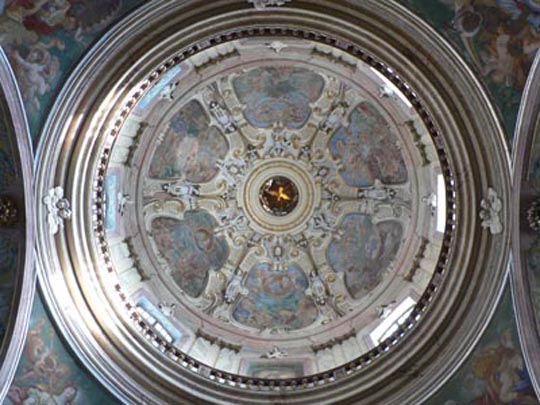 The dome is laid on four bundle pillars, in the niches of which there are statures of the four evangelists. Four pendentives, decorated with fresco paintings by J. K. Handke (1731) rise over the pillars, representing allegories of Europe, Asia, Africa and America. The vault of the dome is divided by the stucco decoration into six cartouches. The frescos show life events of six biblical women: Sarah, Rebecca, Abigail, Bathsheba, Judith and Esther, whose beauty and acts foreshadow, in a certain manner, future character and mission of Virgin Marry. The dome is surmounted with a lantern crowned with a dove, as a symbol of the Holy Spirit.
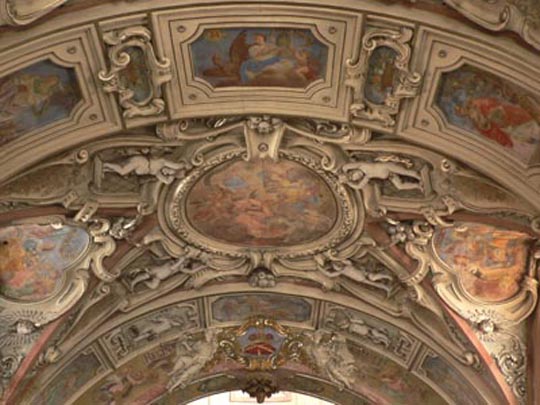 The vault above the nave (from the dove to the organ loft) was decorated in the same time period by the same craftsmen. The four window lunettes imply a hymn on Virgin Mary by four human ages: childhood, juvenility, adult age and old age. Two big oval-shaped fresco paintings depict Virgin Mary’s devotion to God and St. Michael Archangel struggling with the devil
The stucco and plastic decoration of the organ loft constitute a top-rated harmonic whole, belonging to significant sights within the Central-European area. The organ instrument was built in 1722-1725, by the organ manufactory of David Sieber from Brno; the author of figuration on organ case is J. Sturmer. The original valuable baroque disposition was destroyed owing to rebuilding and conversion to a romantic instrument performed by J. Schiffner in 1895. In the period of 1995-1998 the at those days significantly damaged instrument was rebuild by the local organ manufactory of Stavinoha brothers at Valašské Meziříčí.
While entering the church, the visitor is enchanted by the architecture of the high altar, designed by Baldassare Fontana. Retabulum consists of two pairs of columns with pediment and plastic decoration, representing God the Father surrounded with angels. An altarpiece of Visitation of Virgin Mary by J. Spillenberg is embedded in the midst of retabulum. In the front, there is the free-standing altar mensa with the tabernacle and the from above adjoined canopy for the miraculous Marian picture. The marblework was made by J. Hagenmüller and B. A. Fossati, the tabernacle by M. Indegrenz, a goldsmith from Kroměříž, with the use of silver originated from donations from the monastery and inhabitants.
Miraculous Marian Image
The miraculous image of Virgin Mary is relief made of tufa, depicting the Mother of God having the baby Jesus on her right arm; the little Jesus stretching his hand towards the apple his mother holds in her left hand. It is a symbol: Adam and Eve violated God’s command, the Son of God wishes to make up for their sin and for sins of all mankind through his redemptive death. Dimensions of the panel of the painting are 39x21,5 cm, thickness 6,5 cm including the relief; the weight of the panel is 5,75 kg. The painting is completed with polychrome which is not original, but recovered after removing of the two later, during the last restoration of the image in 1979. The image was crowned by Roman crowns in 1732, these were stolen in 1919 together with other votive gifts. New crowns were made and set in the artwork in 1924. On the occasion of canonization of Jan Sarkander and Zdislava of Lemberk, Jan Graubner, the Bishop of Olomouc and Metropolitan Bishop of Moravia expressed the desire to arrange for consecration of those crowns by the Pope. The Holy Father John Paul II consecrated them and he himself crowned the miraculous image during his meeting with young people in front of the basilica on the Holy Hill on 21 May 1995.
Side Chapels
The two largest chapels in the transept are dedicated to St Joachim (right) and St. Joseph (left). The other chapels more close to the main entrance of the church are lower and interconnected.
St. Joachim’s Chapel
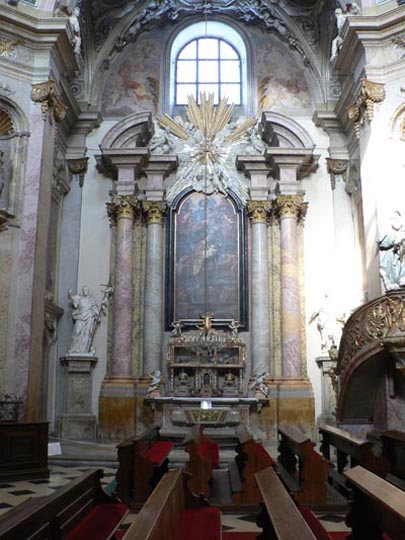
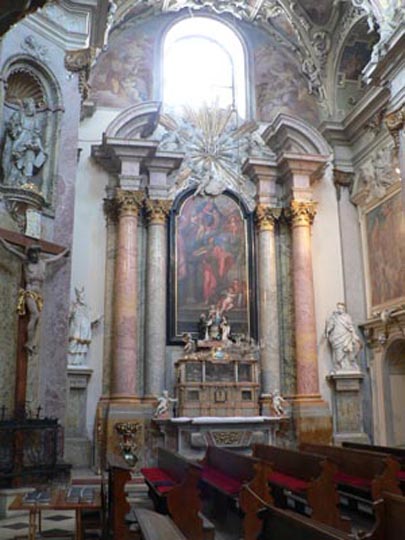 The chapel on the right under the dome is dedicated to the father of Virgin Mary. The centre of the chapel is the altar, decorated with the large retable painting depicting St. Joachim. Above the tabernacle, there is a glass coffin containing a wax figure with remains of St. Victor, the martyr, donated by Pope Innocent XII. in 1692. Alabaster statues on both sides of the altar represent Zechariah, the father of St. John the Baptist (on the left) and King David, author of the Old Testament psalms (on the right).
St. Joseph’s Chapel
 On the opposite side, adjacent to the pulpit, there is the chapel dedicated to St. Joseph, foster father of Jesus. The altarpiece was painted by Tobias Pocke from Vienna in 1681. The tabernacle and both shrines placed on altar mensa had formerly been a part of the wooden high altar of the church. The glass coffin above the tabernacle contains a wax figure with remains of St. Liberatus, the martyr, donated by Pope Benedict XIV. in 1750. Alabaster statues on both sides of the altar sock represent St. John the Evangelist and St. John the Baptist. In the middle under the altarpiece a small gilded statue of St. John Sarkander, who was canonized by Pope John Paul II in Olomouc on 21 May 1995, is placed. On the altar mensa the Roma Madonna can be seen, in memory of the first Roma pilgrimage to the Holy Hill. Its author is the blind artist Božena Přikrylová.
In direction to the entrance, there are two small chapels opposite each other, dedicated to St. Augustine, Bishop and Doctor of the Church, and St. Norbert, bishop. They are both considered to be the spiritual fathers of the Premonstratensian order.
Chapel of St. Augustine
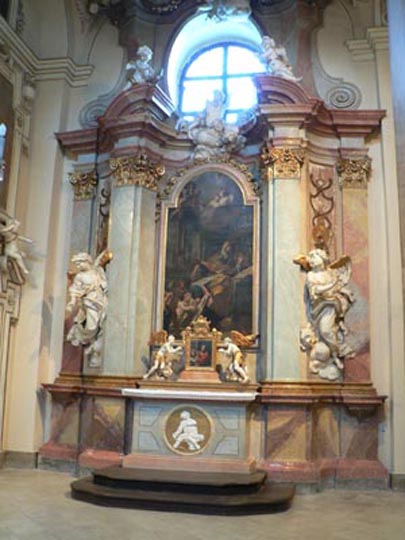 This chapel is the adjacent to St. Joseph’s chapel. Its marble altar is an example of classical column order. The altarpiece dates from 1730 and depicts St. Augustine when meditating on the immense love of God (Jan Kryštof Handke). The smaller picture on altar mensa represents St. Jude Thaddeus – the author of it is unknown. The paintings on walls show scenes from the life of St. Augustine – before his conversion, and then his exemplary life as the Bishop of Hippo.
St. Norbert’s Chapel
The opposite chapel is dedicated to St. Norbert, the founder of the Premonstratensian order. Its altar is in the same style of the classical column order, and its retabulum carries an altarpiece created by Dionysius Friedrich Strauss, a Premonstratensian from Hradisko monastery. The subject of the picture is the vision of St. Norbert which he had during his first stay in a small church of St. John the Baptist in Premontré: Virgin Mary approves of his intention to establish a monastery and hands a white vestment to him – a monastic garb of Premonstratensians. On the altar mensa, there is a small woodcut with shrines and a portrait of the head of Christ by an unknown author. Significant events from the life of St. Norbert are the subject depicted on paintings on the walls and the vault of the chapel.
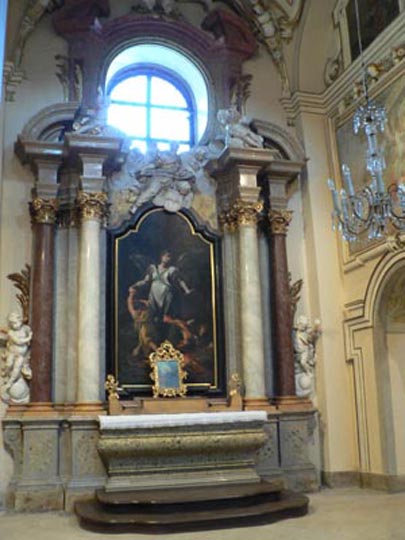 Adjacent to St. Augustine’s chapel, in direction to the main entrance, there is the chapel of the Guardian Angel. The altarpiece painted by Paul Troger from Vienna in 1738 depicts an angel saving a young man from the power of the evil spirit. To better characterize the world of good and evil, the painter used a scale of impressive colors. Fresco painting on the walls remind of the protection provided by angels in various life situations. A small picture of St. Anthony of Padua altarpiece by an unknown author was donated by Marta Andrýsková, the daughter of the founder of the pilgrimage site, member of the Clarist Order, as an expression of gratitude for her recovery from illness.
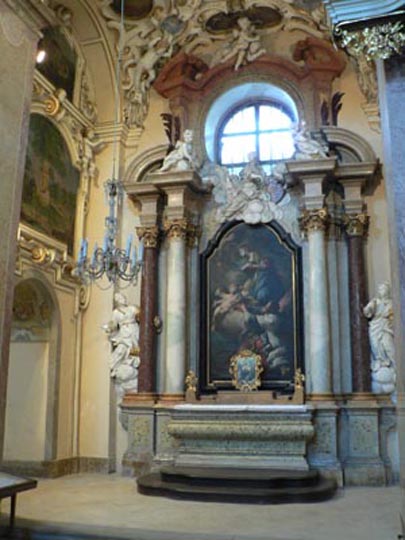 On the opposite side, there is the chapel of St. Pauline, the patroness of Olomouc city. Initially, the first pilgrimage chapel built by Jan Andrýsek stood at the site of the current chapel of St. Pauline. until 1677, when it had to give place to the construction of the new church. Fresco paintings on the walls reflect origins of this pilgrimage site: the Virgin Mary reminds Andrýsek of his promise; Andrýsek finds the place for the chapel; the initial appearance of the chapel, and the first mass celebrated in it, with miraculous healing of the blind man. The author of the altarpiece (1736) is Paul Troger.
The dimensions of the last two chapels situated under the towers are influenced by the footprint of the towers. On the left side, under the northern tower, there is the Chapel of the Most Precious Blood of Our Lord, with symbols of the earthly pilgrimage of men to eternity – pilgrims’ poles – on the vault. The opposite chapel is dedicated to Our Lady of Sorrows, with symbols of the Virgin Mary on the vault.
Other Interesting Objects
The Holy Stairs
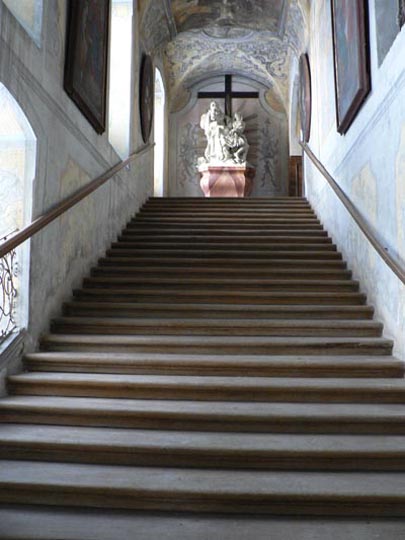 It is an object adjacent from the northern side to the presbytery. Initially, this staircase connected the church with the nearby monastery being of service before the new residences and the cloister were built. After demolition of the monastery the connecting gallery was converted to so called Holy Stairs which were often raised at pilgrimage sites in memory of 28 stairs in the palace in Jerusalem. It is said that Jesus had gone up these stairs on his way to trial by Pontius Pilate. The fresco paintings on the vaults of the gallery and staircase are works of J. K. Handke, an artist from Olomouc. At the top of the staircase, there is an outstanding carving - sculpture – Pieta - made by J. A. Heinz, the carver from Uničov.
The Cloister and the Chapel of the Most Holy Name of the Blessed Virgin Mary
The church complex continues behind the basilica with an open semi-circular cloister with an oval chapel of the Most Holy Name of the Blessed Virgin Mary, creating thus a large courtyard. The architect of the chapel was most probably Domenico Martinelli, a disciple of Jan Blažej Santini. The authorship of a large fresco painting in the vault is accredited to Jan Kryštof Handke and Jan Michal Fisée; it depicts biblical persons (both from the Old, and the New Testament), having relationship to Virgin Mary. The entire stucco decoration – brick columns, pilasters, the molding and sculptures of Israeli kings David and Solomon – are the works of the architect B. Fontana.
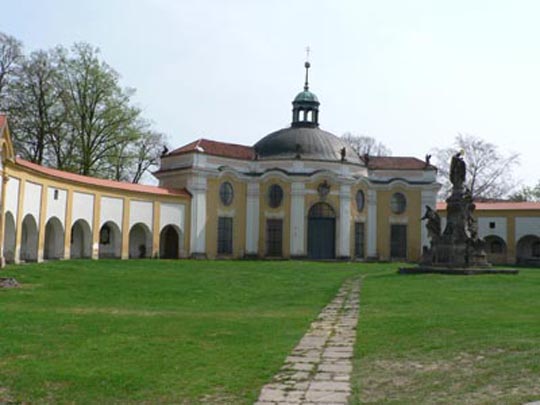 A wooden statue of St. Ann, Mother of the Virgin Mary, from the 19th century, commemorates the annual pilgrimage to Stará Voda near Libavá that started in this chapel every year. The cloister contains two penitent chapels dedicated to St. Peter and St. Mary Magdalene, decorated with stucco paintings by Fontana. Since 1940, the inner walls of the cloister are decorated with carvings of the fourteen Stations of the Cross, made by Jaroslav Kubeček, the wood-carver from Olomouc, based on the order of Marie Čelechovská, Olomouc wine merchant, who also bore the costs. In the middle of the courtyard there is a sculptural group consisting of three figures: St. Norbert and his confreres St. Hugo and St. Evermod, with relief pictures depicting scenes from the saint’s life; this group was created by brothers Joseph and Anthony Winterhalder and placed in the middle of the cloister in 1753.
Bells
In 1689, three bells named Anna, Joachim and Joseph (380, 600 and 1300 kg), cast by Joachim Gross, bell-founder from Vienna, were hung into the north tower. In 1693, a massive bell weighing 3250 kg was cast by the same master and hung into the south tower; it was named Maria. In 1917, this bell was confiscated within World War I requisitions. At the end of World War II, the bell Joachim was destroyed by Soviet troops, as it was hit by one of numerous shells exploded. In 2004-2006, the committee of Matice svatokopecká foundation gathered through public collections and donations of its members, parishioners and other supporters, financial means to cast two new bells. These were cast in the bell foundry Rudolf Perner in Passau, Bavaria, and named as their predecessors: Joachim and Maria. So, the basilica today has again the original number of bells (Joachim and Anna – Maria and Joseph).
Historical Halls
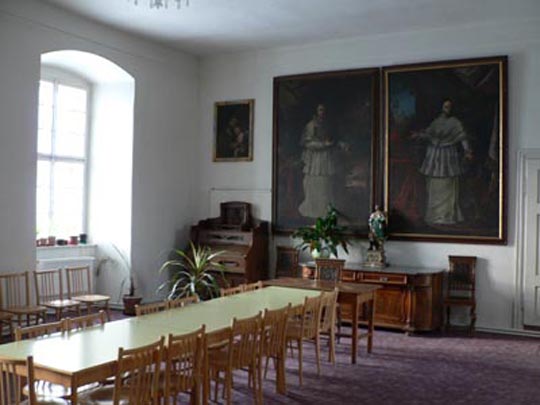 In the south wing of the residence, there are several historical halls: the so called French hall, named probably with regard to former decoration imitating Empire Style (it was destroyed in consequence of soaking and cave-in of the ceiling in 1963. Several large paintings - portraits of abbots from Hradisko monastery – hang on the walls of the hall; at the bottom of each portrait the name of the respective abbot together with the information on the situation with building words of the pilgrimage site at that time. The picture No. 7 – portrait of Abbot Abraham from Střelná – apparently “strayed” from the Hradisko collection of paintings.
Next to the French Hall, there is a small Chinese lounge, the walls of which are decorated with Chinese motifs.
The third in the row, it is the so called Andrýsek Hall. Its walls are covered with baroque paintings on canvas by P. Troger showing the history of the first pilgrimage site and chapel on the Holy Hill, and the ceiling with a large oil-painting of St. Norbert by J. K. Handke, depicting the saint under the Cross of Christ and prospectus of the Hradisko monastery and the Holy Hill.